Towns that built it themselves
Wilson Built Greenlight, Then North Carolina Wrote a Law About It
A municipal fibre network, up and running since 2008, prompted the state legislature to ensure no other city could easily repeat the feat.

A small-city downtown of the kind that private carriers reached late, and that Greenlight was built to serve.
Photo: Sylva, North Carolina, Sept 2011, downtown shops · Wikimedia Commons
A City That Moved Before the Rules Changed
Wilson, North Carolina launched Greenlight in 2008, extending fibre-to-the-premises service across a mid-sized tobacco-belt city of roughly 50,000 people. The city's electric utility already owned poles and rights-of-way; the capital and engineering followed from that foundation. Greenlight offered symmetrical gigabit speeds at rates below what the incumbent cable and telephone providers charged — and it worked. Subscribers signed on; the network covered its operating costs; and Wilson became one of the early proof points that a city could build and run broadband without waiting for a private carrier to find it profitable.
That success made Wilson a target.
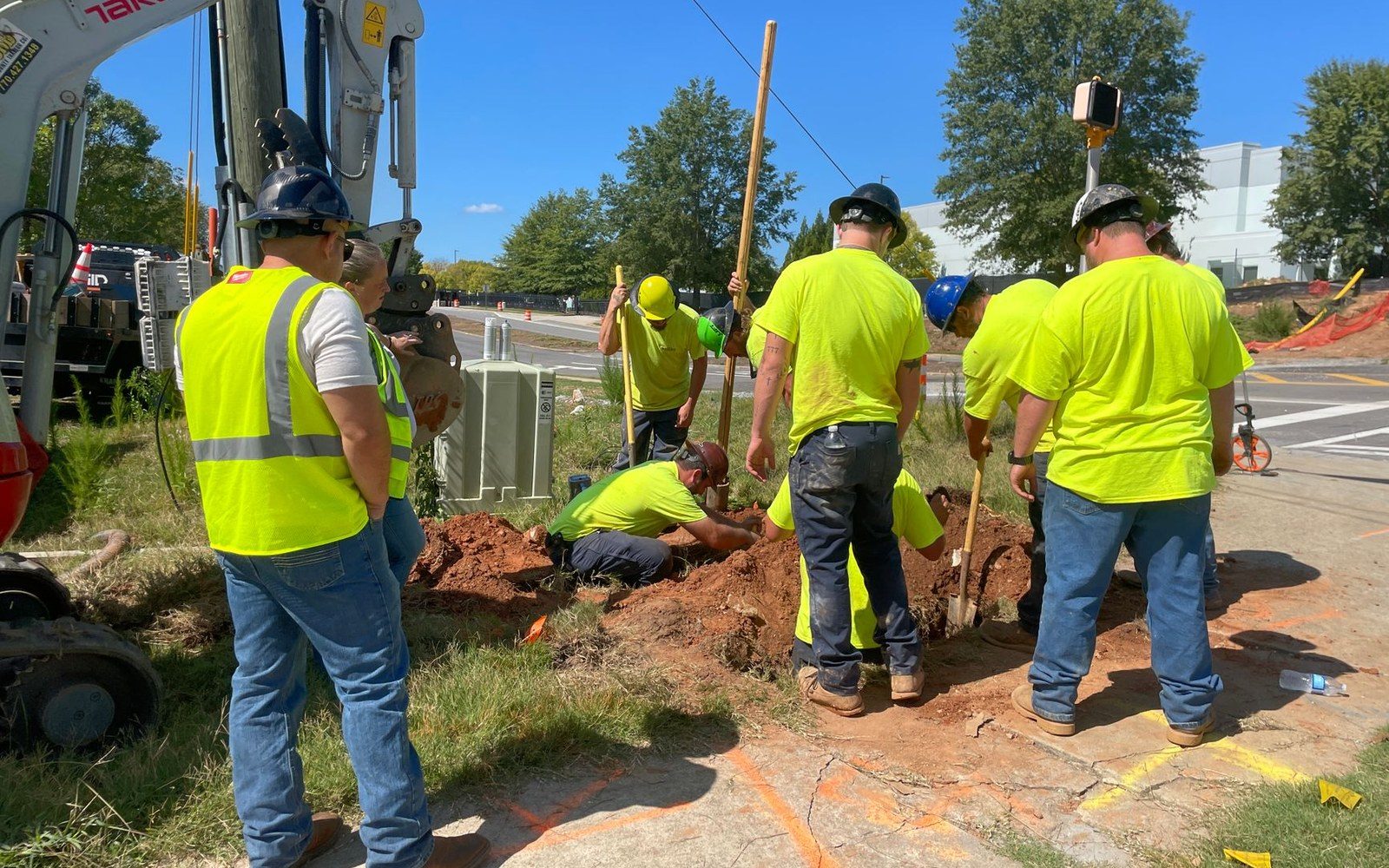
Conduit goes in the parkway strip between sidewalk and kerb, which is why a build is costed in street-miles before it is costed in households.
Photo: Miguel Castillo / Pexels
The Level Playing Field Act, 2011
Three years after Greenlight went live, the North Carolina General Assembly passed House Bill 129, signed into law in 2011 and known as the Level Playing Field Act. The statute did not shut Greenlight down — it was grandfathered — but it imposed a thicket of restrictions on any municipality that might try to follow Wilson's example. Local governments were barred from cross-subsidising a broadband utility with revenues from other city services, required to price services at full cost including imputed taxes, prohibited from expanding service outside their legal jurisdiction, and subjected to procedural requirements that added time and expense to any new build.
The bill's title framed the restrictions as competitive equity. Critics, including researchers at the Institute for Local Self-Reliance, read it differently: as legislation designed to protect Time Warner Cable — Wilson's incumbent provider at the time — from a replicable model. North Carolina joined roughly twenty states that have enacted some form of statute restricting municipal broadband, a pattern state preemption laws across the country have repeated since.

Feasibility studies are public records, and most of them cite the same handful of towns.
Photo: Artem Podrez / Pexels
Greenlight's existing footprint was legally insulated, but a nearby town — Pinetops — that had contracted to receive wholesale service from Wilson was eventually blocked from continuing that arrangement under the new law. Pinetops had fewer than 1,300 households and no realistic prospect of attracting a private fibre builder. The FCC, under then-Chair Tom Wheeler, briefly preempted the North Carolina statute in 2015 to allow the Pinetops service to continue; a federal appeals court reversed that decision in 2016, ruling that the FCC lacked authority to override a state preemption law. Pinetops lost its connection.
Greenlight Today
Wilson's network continued operating through all of it. As of the mid-2020s, Greenlight serves residential and business customers across the city, offering symmetrical multi-gigabit tiers. The city publishes annual financial reports for the utility; the network has not required general-fund subsidy to sustain operations. It remains one of the longest-running continuously operated municipal fibre utilities in the American South.
BEAD — the $42.45 billion Broadband Equity, Access, and Deployment programme administered by the NTIA — allocated funds to North Carolina, and the state must now decide how to deploy them. The Level Playing Field Act remains on the books. That means the BEAD-funded construction in North Carolina will almost certainly flow through private carriers or electric cooperatives rather than through municipalities that might prefer to own infrastructure themselves. Wilson, having built before the restriction existed, operates under a legal position no new city entrant can reach.
The ILSR community network map lists Greenlight among its case studies of successful municipal builds, alongside utilities in Chattanooga and Lafayette. The common thread is timing: each launched before a constraining statute or before incumbent opposition fully mobilised. Wilson's window opened in 2008 and closed in 2011. What the city built in that interval is still running.