Towns that built it themselves
EPB Switched On a Citywide Fibre Utility in 2010, and the Argument Did Not Stop
Chattanooga's Electric Power Board built a fibre network to run its power grid — and ended up running one of the most-studied broadband utilities in the country.

Chattanooga: the utility built the fibre for its own grid first, and sold broadband over the spare capacity.
Photo: Robert Medford / Pexels
The Grid Problem That Became a Broadband Network
When the Electric Power Board of Chattanooga began planning a fibre deployment in the mid-2000s, the primary case was engineering, not economic development. EPB operates the electric utility for Chattanooga, Tennessee and surrounding Hamilton County — roughly 170,000 customer accounts across a service territory that includes older grid infrastructure vulnerable to outage. The utility wanted fibre to carry telemetry data between substations, to automate switching, and to cut the time between a fault occurring and a crew knowing exactly where it was. Broadband for residents was a secondary purpose, bundled onto capacity the grid management system would leave unused.
That framing mattered when EPB went to Washington. The American Recovery and Reinvestment Act of 2009 authorised broadband stimulus grants, and the Department of Energy awarded EPB a $111 million smart grid grant toward a total project cost of roughly $230 million. The grant covered roughly half; EPB's own bonds covered the rest. By 2010, the network was live across the entire service territory — not a pilot area, not a selected census tract, but every address EPB served with electricity.
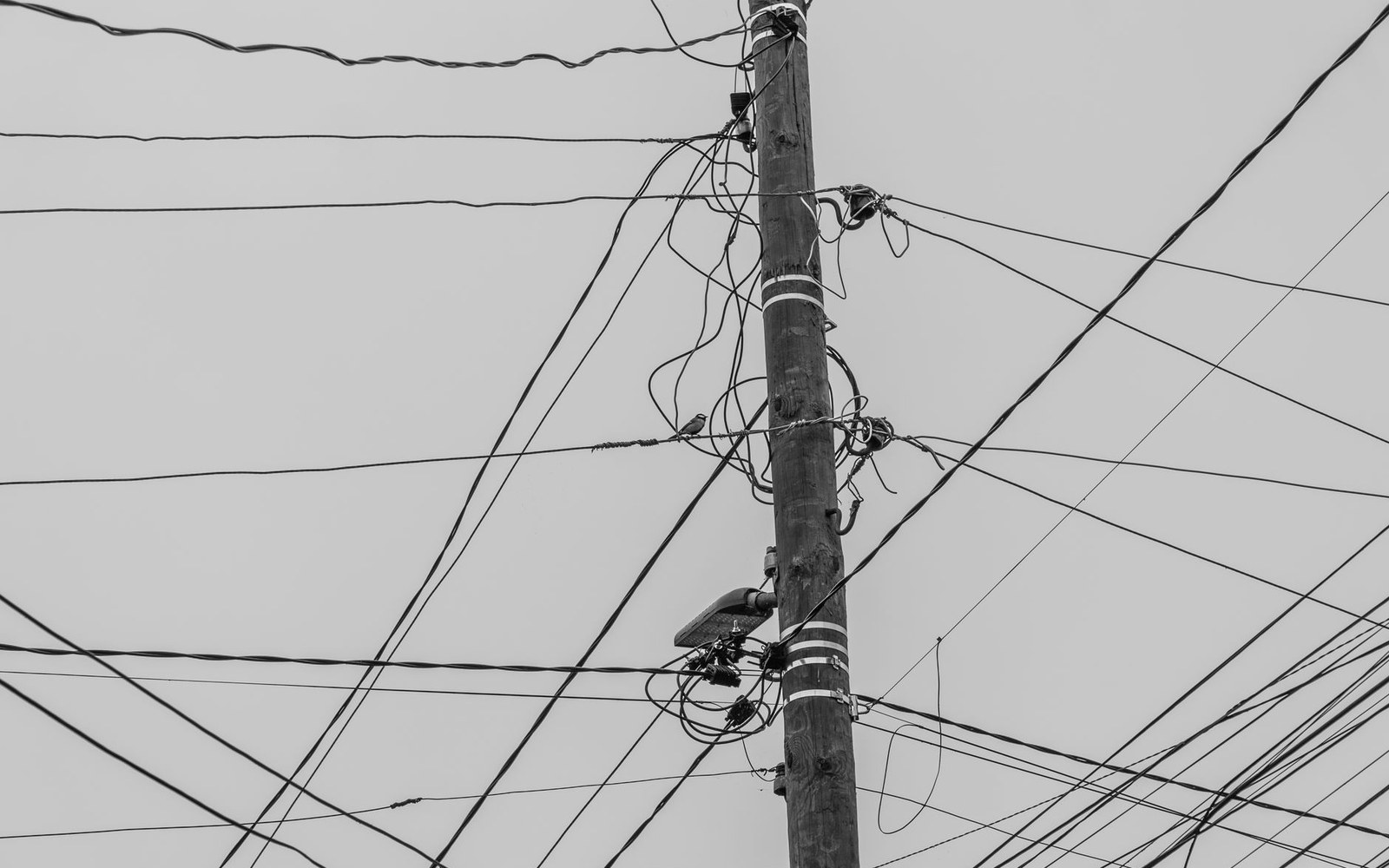
Aerial strand is cheaper than trenching, and the pole it hangs from usually belongs to somebody else.
Photo: Дмитрий Рощупкин / Pexels
The grid argument proved out. EPB has published data showing that automated switching on the fibre-connected smart grid reduced the duration of power outages and the number of customers affected per event. The utility credits the system with saving customers tens of millions of dollars annually in outage-related costs, a figure EPB has updated in successive annual reports. The broadband service rode the same fibre without adding a second construction project.
Gigabit to Every Home
The claim that defined Chattanooga in national broadband conversation was simple: one gigabit per second, symmetrical, available to every residential address in the service territory, starting in 2010. At the time, no other American city of comparable scale had made that offer. Cable operators in most markets were selling download speeds measured in tens of megabits; upload speeds on coaxial plant were a fraction of that, a structural consequence of how DOCSIS allocates spectrum. EPB's fibre carried the same capacity in both directions.
The Institute for Local Self-Reliance, which tracks community broadband networks through its Community Broadband Networks Initiative, documented EPB as one of the earliest large-scale validations that a municipal utility could operate retail broadband sustainably. ILSR's case-study work on EPB has been cited in feasibility studies commissioned by dozens of cities in the years since — not because Chattanooga's demographics or geography are typical, but because the operational and financial data EPB publishes make it a rare specimen: a municipally owned fibre network that has been running long enough to have a track record.
The gigabit tier carried a price that put it out of reach for many households at launch. EPB has offered lower-speed tiers at lower prices throughout its history, and the utility has participated in federal affordability programmes. When the Affordable Connectivity Program was active, EPB enrolled eligible customers. When ACP expired in June 2024, EPB — like every other participating provider — lost that subsidy mechanism. The utility's lower-cost offerings remain, but without the federal discount layer that had reduced monthly bills for enrolled households.
Dual-Purpose Infrastructure and What It Changes
The dual-purpose character of EPB's network — smart grid first, retail broadband second — has a practical consequence that single-purpose broadband utilities do not share: the grid rationale can justify capital expenditure that broadband revenues alone might not. When EPB upgraded the entire network to 10-gigabit capability in 2015, and later conducted trials of multi-gigabit residential service, the underlying fibre plant already existed and was already maintained. The incremental cost of upgrading electronics at the edge was lower than building from scratch would have been.

Selling retail service means staffing a room like this one continuously, whoever owns the strand.
Photo: Fernando Narvaez / Pexels
That structure is not easily replicated. Most municipalities considering broadband do not operate electric utilities, and those that do operate utilities with service territories of varying size and financial profile. Harold DePriest, who served as EPB's chief executive during the network's construction and launch, has described the electric utility's balance sheet and bonding authority as foundational to the project's financing — a baseline that a standalone broadband authority would have had to establish from nothing. The EPB model is instructive precisely because it is not transferable wholesale; what transfers is the principle that infrastructure built for one grid purpose can carry communications traffic at marginal additional cost.
Fourteen Years of Citations
The practical consequence of Chattanooga's longevity is that it has become the default comparator in municipal broadband feasibility work. A feasibility study commissioned by a mid-sized city will almost certainly contain an EPB case study in its appendix — not as a template to copy, but as evidence that the category of project is viable. The Benton Institute for Broadband and Society has noted EPB repeatedly in its policy work as a demonstration that public ownership of fibre infrastructure is compatible with operational stability over a multi-year horizon.
That citation function is a double-edged thing. Cities that have studied EPB and then encountered state preemption laws — the roughly twenty state statutes that restrict or prohibit municipalities from building their own networks — have found that the existence of a successful precedent in Tennessee does not dissolve a legal barrier in their own state. Tennessee itself added restrictions after EPB's network launched, limiting EPB's ability to expand its broadband service beyond its existing electric utility territory even when adjacent communities requested service. EPB sought and was denied permission to extend to neighbouring counties; the Tennessee legislature declined to lift the restriction despite the utility's operational record.
The BEAD programme, the $42.45 billion that the NTIA is distributing through state broadband offices to fund construction in unserved and underserved locations, has renewed the argument about who should build. States with strong preemption laws face the question of whether municipal entities can compete for BEAD subgrants or serve as last-resort providers in areas private ISPs decline to serve. EPB's record gives advocates a concrete answer to the capability question; the legal and legislative question remains open state by state.
What Chattanooga demonstrated, and what fourteen years of continuous operation has not dislodged, is narrower than its advocates sometimes claim and broader than its critics allow. A public utility that already has poles, rights-of-way, customer billing relationships and bonding capacity can build and run a fibre network. The argument about whether any given community should do so — given its financial position, its state law, its existing competition and its political will — did not stop in 2010, and EPB's record will continue to be evidence in it.