The technology underneath
Starlink's Published Numbers, Against the FCC Definition
SpaceX's LEO satellite service only straddles the FCC's download bar — and falls short on upload almost every time.

A dish on a roofline reaches addresses no wire does, at published speeds that trail fibre.
Photo: starlink.com
What the Datasets Show
The FCC's 2024 fixed broadband benchmark, revised from 25/3 Mbps to 100 Mbps download and 20 Mbps upload, defines the floor for a location to be counted as served. Starlink's performance against that standard depends heavily on which metric you examine and where the subscriber lives.
Ookla's Speedtest Intelligence data for the United States, published through its public-facing reports, placed Starlink's median download speed in the range of 70–100 Mbps during recent measurement periods — straddling the benchmark rather than comfortably clearing it. Median upload speeds in the same datasets landed between 10 and 15 Mbps, consistently below the 20 Mbps upload threshold. M-Lab's Network Diagnostic Tool measurements, drawn from a different user population and methodology, record broadly similar upload results and somewhat lower download medians, reflecting the tool's tendency to capture a wider spread of real-world conditions.

Aerial strand is cheaper than trenching, and the pole it hangs from usually belongs to somebody else.
Photo: Дмитрий Рощупкин / Pexels
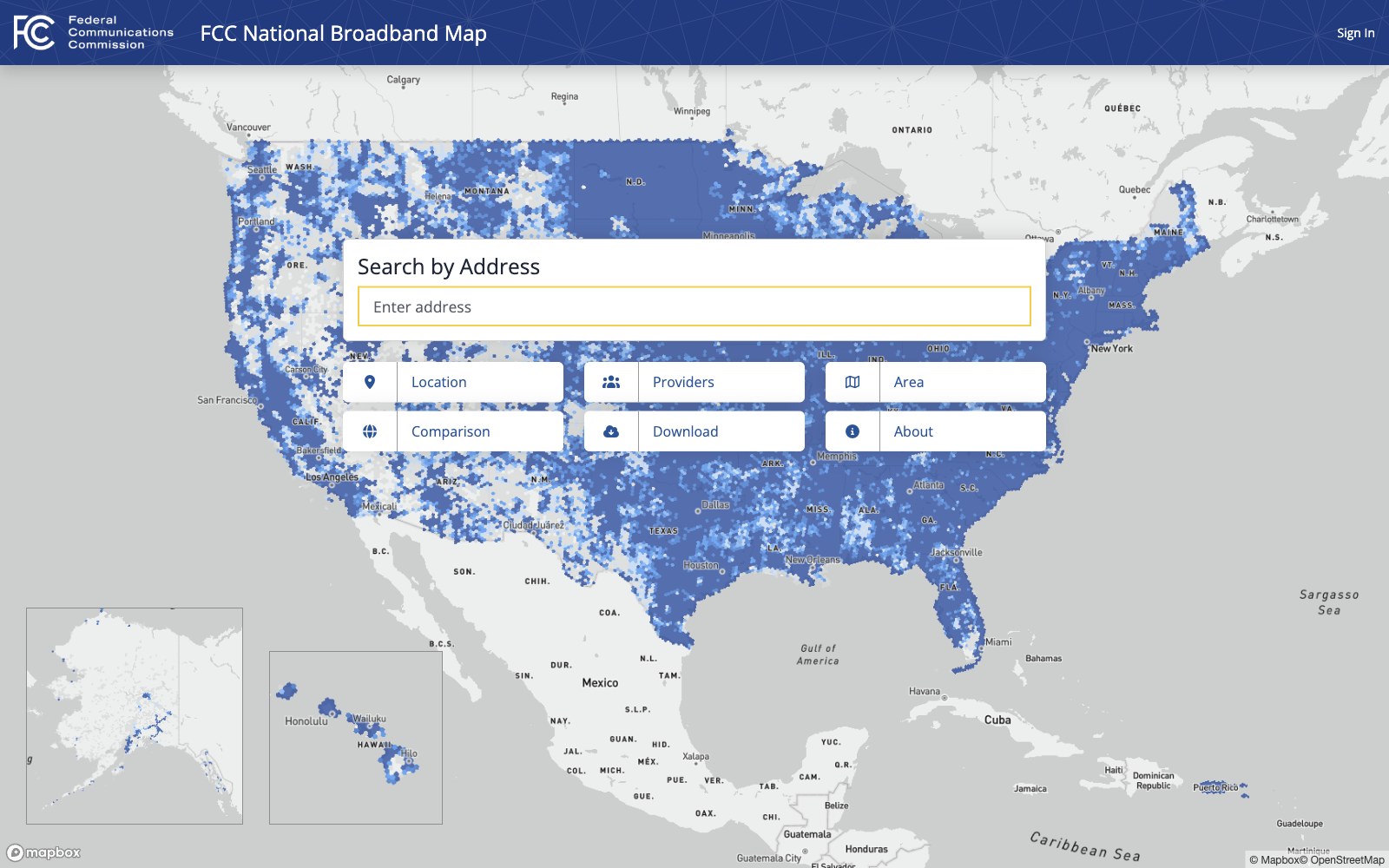
The national map is assembled from provider self-reporting, which is the reason the challenge process exists.
Photo: broadbandmap.fcc.gov
Latency tells a distinct story. Geostationary broadband satellites orbit at roughly 35,000 km, producing round-trip times above 600 milliseconds. Starlink's constellation operates below 600 km, and M-Lab data attributes median round-trip latency to Starlink in the 40–60 ms range, meaningfully lower than legacy satellite and adequate for most common applications, though still above the sub-20 ms typical of a well-provisioned fibre connection.
SpaceX markets Starlink as available across all 50 states and claims expanding capacity through continued satellite launches. Rural and tribal areas — locations the NTIA's BEAD programme targets precisely because wireline infrastructure is absent — represent the service's largest potential addressable market. On the FCC map, a location where Starlink is available is recorded as served by a provider capable of fixed broadband; whether it meets the 100/20 standard at a given address turns on the measured performance, not the coverage claim.
The gap between download adequacy and upload shortfall matters for remote workers, telehealth and small-business users for whom symmetrical throughput is not optional.