The money, and where it stalled
Twenty-Three Million Households, Then the Funding Ran Out

The subsidy was applied to the monthly bill, so its expiry changed the price rather than the wiring.
Photo: skokienet asset kit
What the Affordable Connectivity Program Did
The Affordable Connectivity Program launched in December 2021 as the successor to the Emergency Broadband Benefit, itself a pandemic-era stopgap that Congress had authorised in 2020. Where the Emergency Broadband Benefit paid up to $50 a month toward a qualifying household's internet bill, the ACP settled at a smaller but more sustainable-sounding figure: up to $30 per month for most households, and up to $75 per month for those on Tribal lands. A one-time discount of up to $100 was also available toward a connected device. Administration fell to the Universal Service Administrative Company, which already managed the E-Rate and Lifeline programmes on behalf of the Federal Communications Commission.
Eligibility was broad by design. A household qualified if any member participated in Medicaid, SNAP, Supplemental Security Income, Federal Public Housing Assistance, or several other assistance programmes, or if household income was at or below 200 percent of the federal poverty level. Veterans' survivors' benefits and the Federal Pell Grant also opened the door. The width of that eligibility net was precisely the political argument for the programme: this was not a niche subsidy but a benefit touching tens of millions of Americans who were already enrolled in other federal programmes and simply lacked affordable internet access.
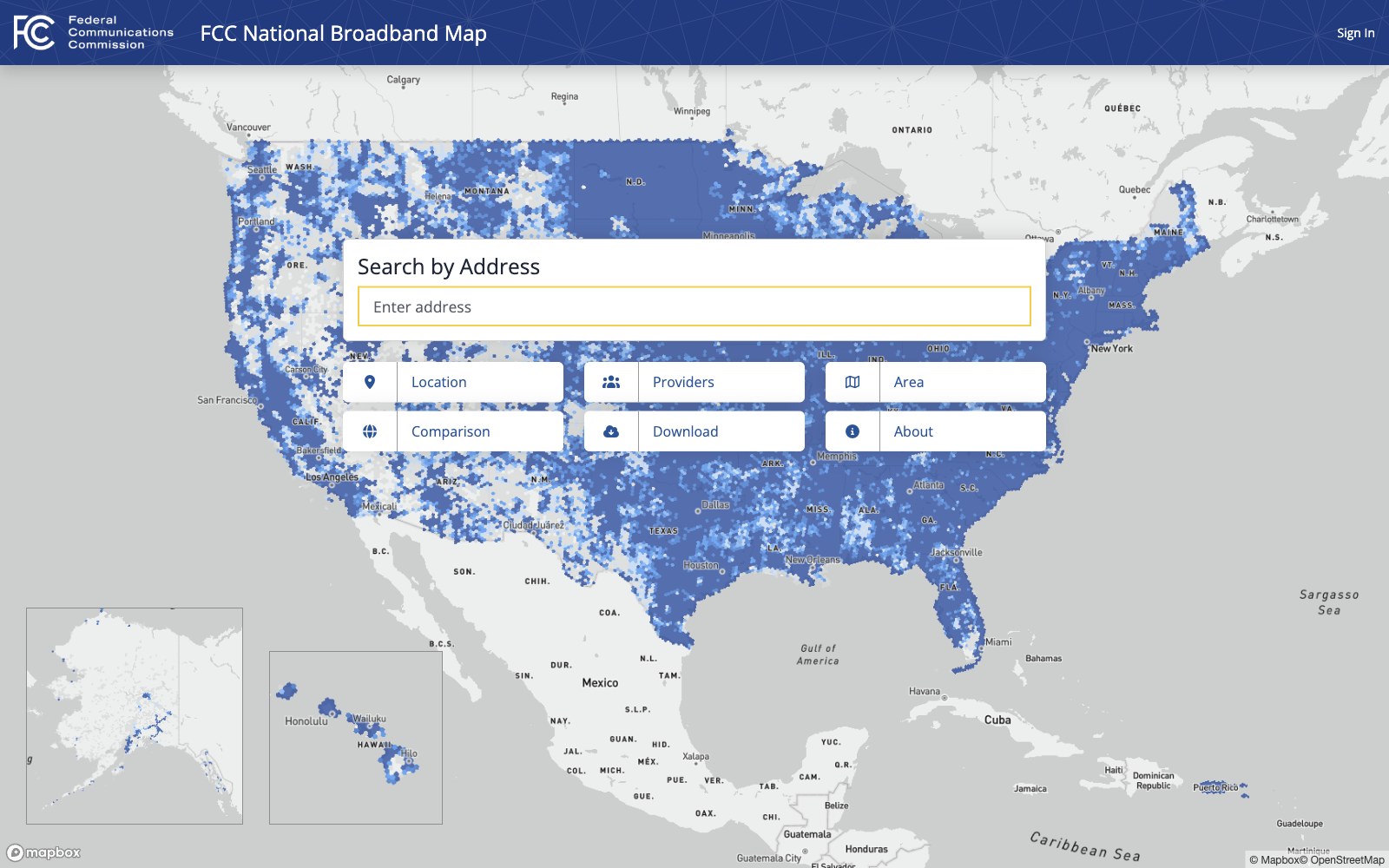
The national map is assembled from provider self-reporting, which is the reason the challenge process exists.
Photo: broadbandmap.fcc.gov
Enrollment climbed steadily. By early 2024, USAC was reporting more than 23 million households enrolled across all fifty states, the District of Columbia and the territories. That figure made the ACP one of the largest federal broadband-subsidy efforts in American history, dwarfing anything the Universal Service Fund had reached through its Lifeline programme alone.
The Funding Gap and Congress's Non-Decision
The Infrastructure Investment and Jobs Act of 2021 had appropriated $14.2 billion for the programme — a sum that seemed substantial when enrollment projections were modest, but one that the scale of actual participation began visibly consuming. The FCC, then chaired by Jessica Rosenworcel, warned publicly as early as mid-2023 that the fund was on a defined trajectory toward exhaustion. The commission urged Congress to replenish it.

A library's public-computing shelf. The institution was an access point before home broadband was the ordinary case.
Photo: Pixabay / Pexels
The Affordable Connectivity Program Extension Act, which would have added roughly $7 billion to keep the programme running, attracted bipartisan sponsorship from legislators including Ben Ray Luján and Deb Fischer in the Senate and Anna Eshoo in the House. The bill did not advance to a floor vote. Negotiations over the federal budget in late 2023 and early 2024 did not produce a replenishment package, and no stand-alone measure cleared either chamber.
With the fund running down, the FCC announced in February 2024 that new enrollments would be frozen effective February 7, 2024. Existing subscribers received a final full benefit in April 2024. In May, that benefit was reduced to $14 for most households — roughly half the standard subsidy — as USAC managed the remaining dollars across the enrolled base. The programme stopped accepting new applications and wound down benefit payments entirely by June 2024.
Who Was Left Without
The discontinuation did not fall evenly. Pew Research Center survey data collected in spring 2024 found that lower-income households, Black and Hispanic adults, and residents of rural areas were disproportionately represented among ACP enrollees — the same populations BEAD is simultaneously trying to reach with physical infrastructure. A household losing its ACP benefit faced either absorbing the full retail internet bill, which for a basic cable tier typically ran between $60 and $80 per month before promotional periods expired, or dropping service.
No federal programme directly replaced the ACP on the same scale. Lifeline, also administered by USAC, continued to offer up to $9.25 per month — a fraction of the ACP's benefit. BEAD, the $42.45 billion construction programme administered by the NTIA, funds fibre and fixed wireless deployment but carries no affordability component; getting a line to a home and keeping service affordable are governed by entirely separate budget lines, separate legislation, and, as June 2024 demonstrated, separate political fates.