The money, and where it stalled
The FCC Moved the Bar to 100/20 in 2024
A number that sat unchanged for a decade was finally revised — and the redefinition quietly reclassified millions of locations.
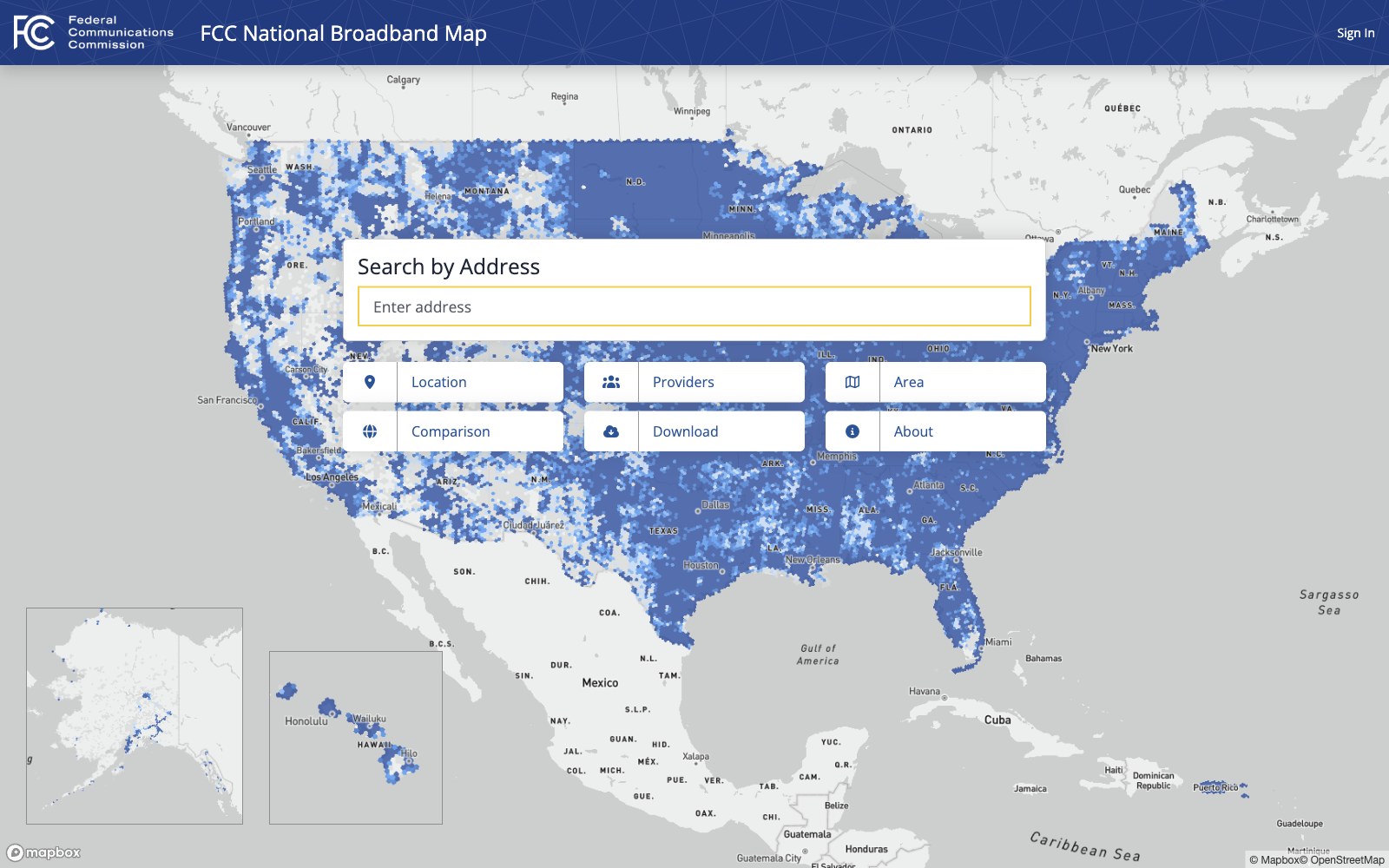
The national map is assembled from provider self-reporting, which is the reason the challenge process exists.
Photo: broadbandmap.fcc.gov
What Changed and Why It Matters
For nearly a decade, the Federal Communications Commission defined adequate fixed broadband as 25 Mbps download and 3 Mbps upload — a benchmark set in 2015 that became increasingly difficult to defend as video conferencing, cloud storage and multi-device households became ordinary. In March 2024, the FCC adopted a new fixed broadband standard of 100 Mbps download and 20 Mbps upload, replacing the 25/3 figure it had held through years of political controversy.
The practical significance is immediate. Any location receiving service below 100/20 Mbps is now, by the commission's own definition, underserved. That matters for BEAD funding eligibility, for Universal Service Fund programme design, and for the FCC's own Broadband Data Collection — the data layer underneath the national broadband map. Providers that previously reported a location as served under the 25/3 standard may now find it reclassified, opening it to federal subsidy competition they had assumed was foreclosed.

Feasibility studies are public records, and most of them cite the same handful of towns.
Photo: Artem Podrez / Pexels

A library's public-computing shelf. The institution was an access point before home broadband was the ordinary case.
Photo: Pixabay / Pexels

The commission that sets the benchmark also collects the deployment data measured against it.
Photo: FCC New Logo · Wikimedia Commons
The upload figure drew particular attention. At 20 Mbps up, the new standard finally acknowledges the asymmetrical architecture of most cable plant. Coaxial HFC networks built under DOCSIS standards historically allocate far more bandwidth downstream than upstream; many cable subscribers receiving advertised 100 Mbps downloads receive 10 Mbps or less on upload. Those locations are underserved under the new definition even when download speeds are nominally adequate.
Municipal fibre networks sit comfortably above the line. EPB in Chattanooga, LUS Fiber in Lafayette, and Wilson's Greenlight network all launched with symmetrical gigabit service — 1,000 Mbps in both directions — making the 100/20 threshold a low bar by their standards. Fixed wireless deployments, by contrast, are more variable; many rural fixed wireless providers deliver download speeds near or above 100 Mbps but struggle to match the 20 Mbps upload requirement consistently.
The 2024 revision also carries a long-term signal: the FCC simultaneously stated a longer-run aspirational goal of 1,000/500 Mbps, framing current infrastructure investment decisions against that trajectory. That framing matters for communities now choosing between hybrid-fibre-coax upgrades and full fibre builds. A network that reaches 100/20 today on upgraded cable may still fall below the next benchmark revision.
What the new number does not fix is the map itself. Reported speeds remain provider self-certifications, and the challenge process for disputing inaccurate entries is slow and uneven. A better benchmark applied to unreliable data produces a more accurate definition of the problem — but not yet an accurate count of where it exists.