The technology underneath
Three Ways to Wire a Block, and Why They Are Not Equivalent

Three ways to wire a block, and only one of them is symmetrical by design.
Photo: Karas Hoshi / Pexels
The strand, the coax and the signal in the air
Three delivery technologies dominate American broadband infrastructure — fibre-to-the-premises (FTTP), coaxial hybrid-fibre-coax (HFC) cable and fixed wireless access (FWA) — and each answers the FCC's 100/20 Mbps benchmark very differently. The distinctions are architectural, not incidental, and they compound over time.
Fibre-to-the-premises runs a strand of glass from a network head-end all the way to the subscriber's wall jack. Light carries the signal; the medium does not degrade with distance the way copper does; and because the same strand handles upload and download, symmetry is a design choice rather than a physical constraint. An FTTP connection provisioned at 100/100 Mbps is symmetrical by default. A connection provisioned at 1/1 Gbps is equally symmetrical. The upload ceiling is the same strand as the download ceiling. That matters for the 100/20 FCC definition — but it matters more in practice, because video conferencing, cloud backup and remote-desktop traffic saturate upload capacity in ways that the 20 Mbps floor only barely accommodates.
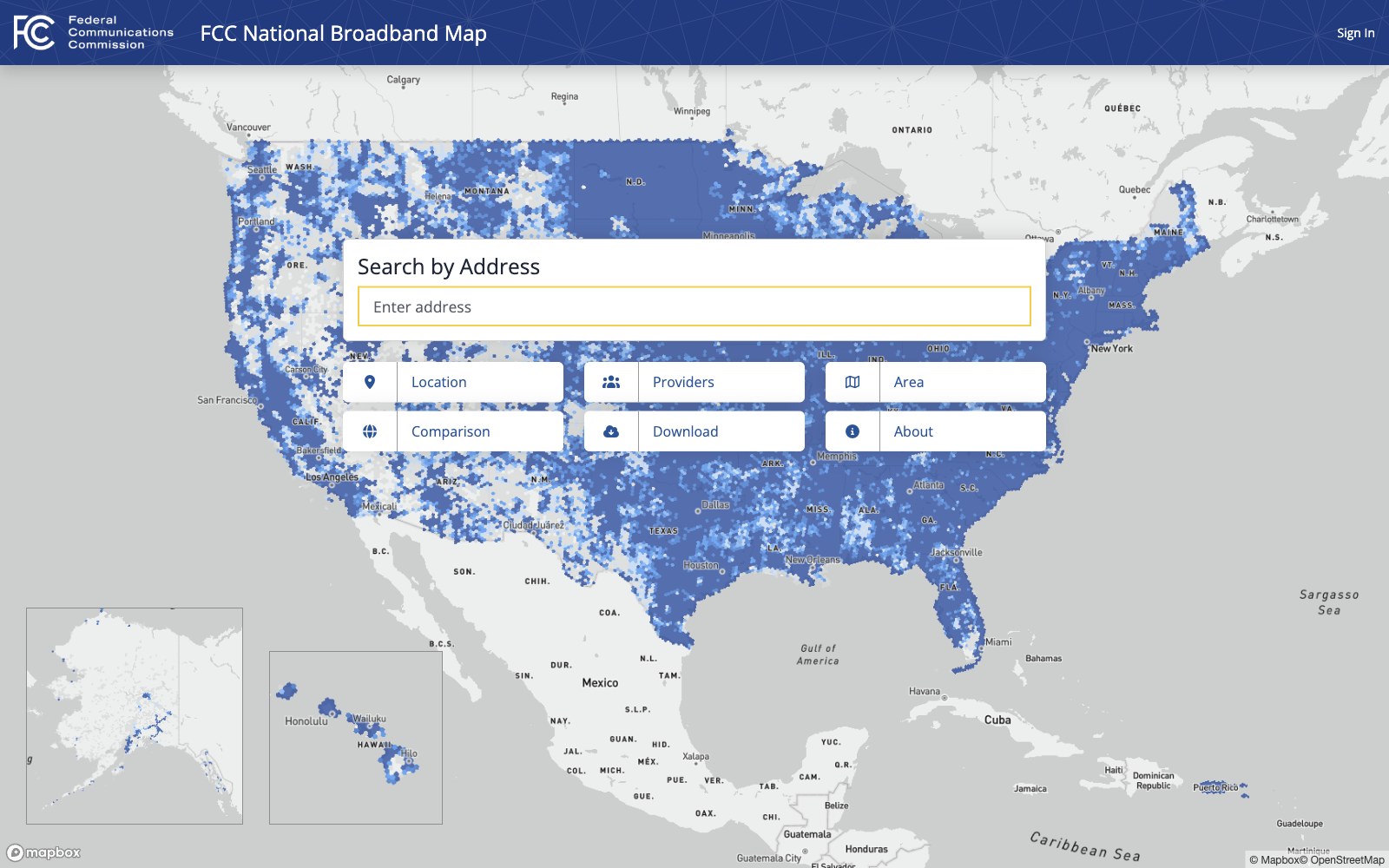
The national map is assembled from provider self-reporting, which is the reason the challenge process exists.
Photo: broadbandmap.fcc.gov
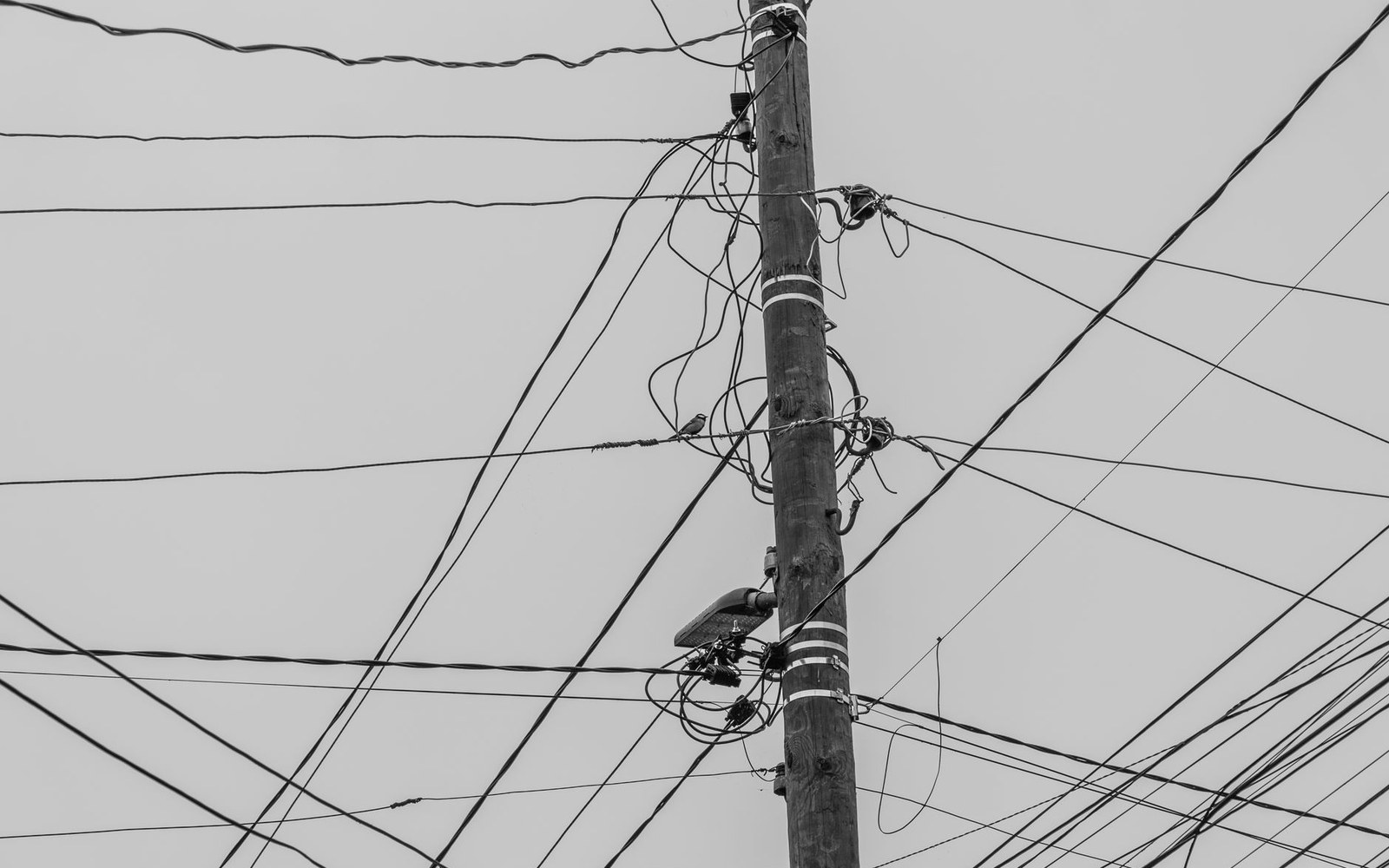
Aerial strand is cheaper than trenching, and the pole it hangs from usually belongs to somebody else.
Photo: Дмитрий Рощупкин / Pexels
HFC cable plant works differently at a structural level. Fibre runs from the cable company's hub to a neighbourhood node; from the node, coaxial copper carries the signal to individual premises. The coax segment is a shared medium — every subscriber on a node competes for the same radio-frequency spectrum. DOCSIS 3.1, the current dominant standard, allocates most of that spectrum to downstream traffic by design, because the technology was engineered for one-way television distribution. Upload channels occupy a narrow slice of the lower frequency band. DOCSIS 3.1 can provision downstream speeds well above 100 Mbps, but upload capacity is structurally limited and shared. During peak hours, when many households on a node draw simultaneously, congestion appears first — and worst — in the upload direction. DOCSIS 4.0 promises to expand upstream spectrum, but deployment is early and capital-intensive; the coax plant itself remains shared. As the ILSR's community broadband tracking work has documented across dozens of municipal network case studies, the congestion ceiling on HFC is a recurring reason local governments commission feasibility studies for fibre alternatives.
Fixed wireless access introduces a further variable: spectrum. A tower transmits a radio signal to an antenna at the subscriber's premises; the subscriber's upload and download compete for shared radio channels in licensed or unlicensed bands. Throughput depends on distance from the tower, line-of-sight obstruction, local radio-frequency congestion and how many subscribers share a sector. Published median speeds from Ookla and M-Lab testing show that FWA products from T-Mobile and Verizon routinely meet 100 Mbps downstream under good conditions, but upload performance is variable and typically asymmetrical. Rain, foliage and building materials attenuate signal. A sector that performs well at low subscriber density may degrade as take-up rises, because spectrum — unlike a fibre strand — is a shared resource with a hard physical ceiling.
Capital structure shapes who builds what
The three technologies also carry different cost profiles, and those profiles explain which entities find each buildable. FTTP requires high upfront capital — trenching or aerial strand across every address in a service area — but ongoing operating costs are low and upgrade capacity is substantial: the glass does not change when electronics at each end improve. A municipal utility or cooperative can amortize that capital over decades. A private operator seeking short payback periods finds FTTP economics harder to justify in low-density areas, which is the premise behind the BEAD programme's $42.45 billion in federal subsidy directed at exactly those locations.
HFC cable plant was already buried by private operators decades ago. Upgrading it to DOCSIS 4.0 is expensive but far cheaper than re-trenching. Incumbents defend that sunk investment; new entrants have no reason to build HFC from scratch.
Fixed wireless access has low tower-to-subscriber capital costs relative to fibre, which is why it appears frequently as a first response in unserved rural areas. But the spectrum constraint means it cannot scale symmetrical capacity the way fibre can. It is a different answer to a different question — useful where trenching is economically or physically impractical, but not a substitute for glass when the design goal is durable, uncongested, symmetrical service.