Skokie and the North Shore
Service in One Suburb Is Not Service in the Next
Where a carrier's territory ends, a resident's options narrow — and the line runs through neighbourhoods, not just between cities.

Carrier service territories stop at boundaries that do not match the suburbs they cross.
Photo: Quang Vuong / Pexels
How Coverage Boundaries Cut Across the North Shore
The Chicago metropolitan area's North Shore suburbs sit close enough together that a resident of Skokie can walk to Morton Grove in twenty minutes. Broadband service maps do not respect that proximity. The FCC's national broadband map, which draws availability from provider self-reported data, shows carrier footprints ending at municipal boundaries — or partway through a block — leaving adjacent addresses in materially different competitive positions depending on which side of a village limit they occupy.
Evanston, immediately north of Chicago, has historically attracted denser carrier overlap than its neighbours. Comcast's coaxial HFC plant and AT&T's DSL and fibre-to-the-node infrastructure both cover substantial portions of the city, and the presence of Northwestern University has pulled enterprise-grade connectivity into the corridor. Morton Grove and Niles, to the west and southwest of Skokie, present a thinner picture: incumbent coverage in those municipalities relies heavily on Comcast's cable franchise and AT&T's older copper-based plant, with fibre-to-the-premises availability considerably less widespread than FCC summary statistics suggest when individual addresses are examined through the map's location-level interface.

Feasibility studies are public records, and most of them cite the same handful of towns.
Photo: Artem Podrez / Pexels
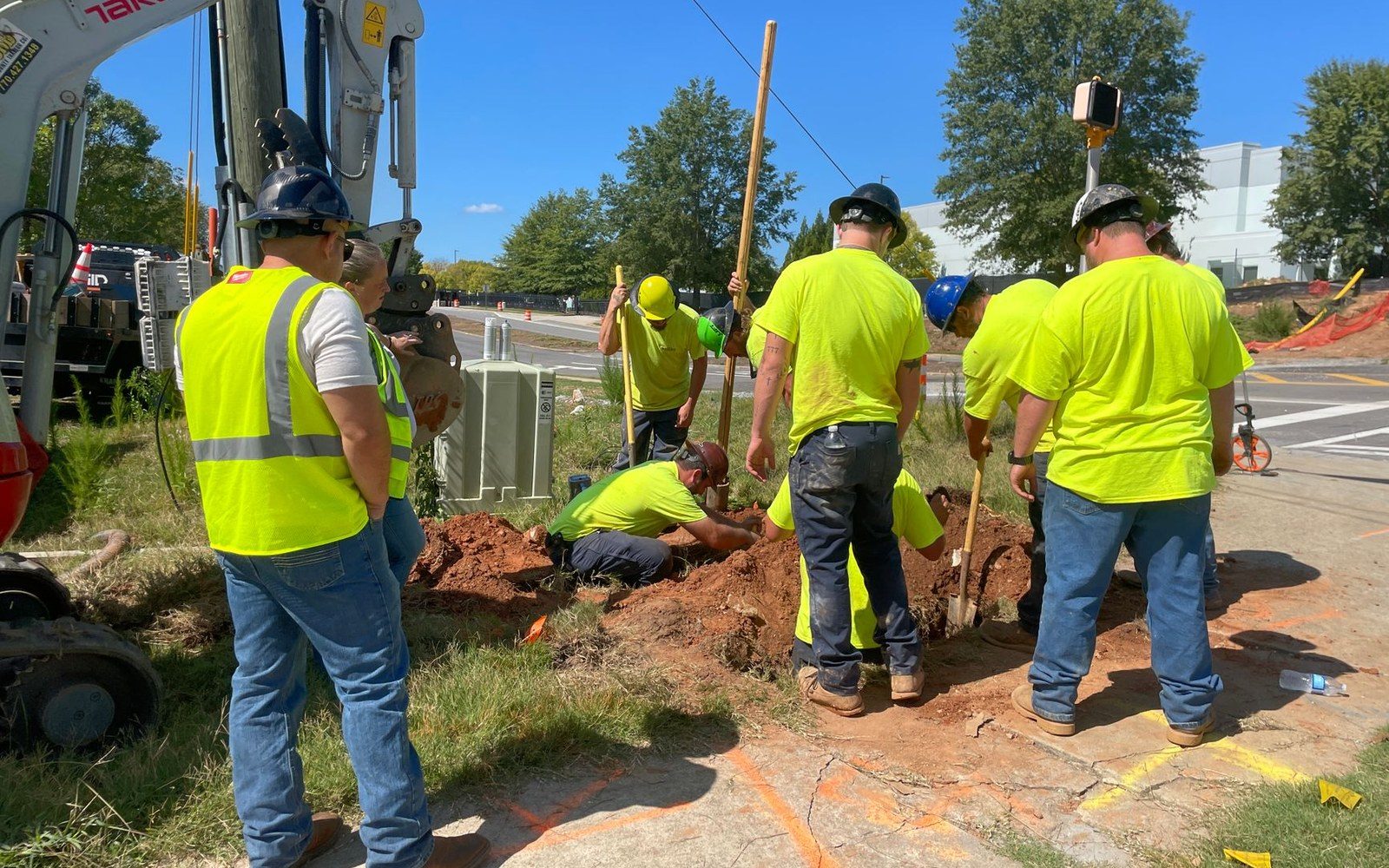
Conduit goes in the parkway strip between sidewalk and kerb, which is why a build is costed in street-miles before it is costed in households.
Photo: Miguel Castillo / Pexels
Skokie sits in the middle of this patchwork. The FCC's national broadband map shows strong nominal coverage across the village, yet the map's reliance on provider self-reporting means that a location marked "served" may receive speeds well below the FCC's current 100/20 Mbps benchmark, or may have only a single provider available in practice. The Village of Skokie has documented its own fibre infrastructure in publicly available board materials, and that municipally owned strand represents a capacity layer that simply does not exist in Morton Grove or Niles, where no equivalent utility-scale fibre programme has been undertaken.
The Gap Is Structural, Not Incidental
The unevenness across these four municipalities is not a temporary coverage hole waiting to be filled by a market correction. It reflects how carrier franchise territories, capital allocation decisions, and state regulatory structures interact over decades. Illinois does not impose the most restrictive preemption statute in the country, but it does not actively compel carriers to serve every parcel within a franchise area uniformly, and state preemption laws in neighbouring states have demonstrated how quickly a legal barrier can freeze the map for years. The result in the North Shore corridor is a service landscape shaped more by the economics of carrier build-out than by any public planning process.
When a Niles resident's only competitive option is Comcast at a given address, that resident pays whatever Comcast prices — because AT&T's plant at that block may not reach above DSL speeds, and fixed wireless alternatives introduce the latency and capacity constraints that come with shared radio spectrum. A half-mile east, inside Skokie's boundary, the presence of the village's own fibre infrastructure changes the leverage relationship, even for residents who do not connect directly to it, because it creates an independent capacity option that carriers must price against. Morton Grove has no equivalent counterweight.
The Institute for Local Self-Reliance has tracked this dynamic nationally: the existence of a municipal or cooperative network in a market tends to lower prices and raise speeds offered by incumbents in the same geography, an effect that does not cross a jurisdictional line cleanly. Residents in the municipalities adjacent to a publicly built network absorb none of that competitive pressure.
The BEAD programme's $42.45 billion, administered by the NTIA, is targeted at unserved and underserved locations — a definition anchored to the FCC map that these same suburban municipalities have limited power to challenge without sustained, address-level documentation. Evanston, Morton Grove, and Niles have filed less of that documentation than communities with dedicated broadband staff. Skokie, which has operated infrastructure and generated internal planning records, is better positioned to contest misclassified addresses. That administrative capacity, accumulated quietly over years, is itself a form of broadband infrastructure — and it does not transfer across village limits any more than the fibre does.